
Sales to Customer Success Handoff: A Step-by-Step Guide
A good sales to customer success handoff is a week of small, owned steps from closed-won to day 30, not one meeting. On close day, the account executive writes down why the customer bought, every promise made and who matters, then walks Customer Success through it before kickoff. In our own review of 11 free handoff templates, only 4 asked anyone to check sales promises against the contract.

What is a sales to customer success handoff?
A sales to customer success handoff is the moment a closed deal moves from the account executive who sold it to the customer success team that has to deliver it. Done well, the handoff from AE to CSM passes along the customer's reasons, promises and people in writing, so nobody on the customer's side has to tell their story twice.
It matters because the first weeks after signature are when trust is easiest to lose. In GUIDEcx's 2026 survey of 200 B2B onboarding professionals, 62% said their company had lost at least one customer to a poor onboarding experience, and 16% named a poor sales-to-onboarding handoff as their single biggest onboarding challenge.
Independent research points the same way. A peer-reviewed study in the Journal of the Academy of Marketing Science followed 74,871 new contracts at one large B2B software provider and found that only about 82% were still in place when onboarding ended. It's one company's data from 2015 to 2018, but it counts real contracts, not opinions about them. We covered that early window in why Closed-Won breaks in the first 48 hours.
This guide is about timing and ownership: who does what, on which day, from closed-won to customer success and on to day 30. If you only want the one-page list of what to collect, our sales to CS handoff checklist and the sales-to-CS handoff overview cover that.
Why does the handoff break, and what changed in 2026?
The handoff usually breaks because the context lives in people's heads, call recordings and chat threads, not in one document that someone owns. In 2026 the pressure rose on both sides: onboarding is being measured as a revenue function, and AI tools now draft notes faster than teams can check them.
OnRamp's 2026 State of Onboarding report, based on 161 customer success and onboarding leaders, names misalignment between sales and CS during the handoff as one of the three biggest blockers to scaling onboarding, alongside manual handoffs and data scattered across tools. The same report found that 57% of onboarding teams now report into the chief revenue officer or revenue operations.
On the sales side, AI agents are arriving quickly. Salesforce's 2026 State of Sales research, a survey of 4,050 sales professionals, found that 54% of sellers have used AI agents and nearly nine in 10 plan to by 2027. Gartner adds a caution. It predicts AI agents will outnumber sellers ten to one by 2028, yet fewer than 40% of sellers will say agents improved their productivity, and it warns that agents running on fragmented systems will scale the fragmentation.
Our read: an AI agent can write a handoff note in seconds, but if nobody decides what goes in it and who checks it, it just moves incomplete information faster. GUIDEcx makes the same point about onboarding automation. The steps below put a named person at every decision.
How do you run the handoff step by step, from closed-won to day 30?
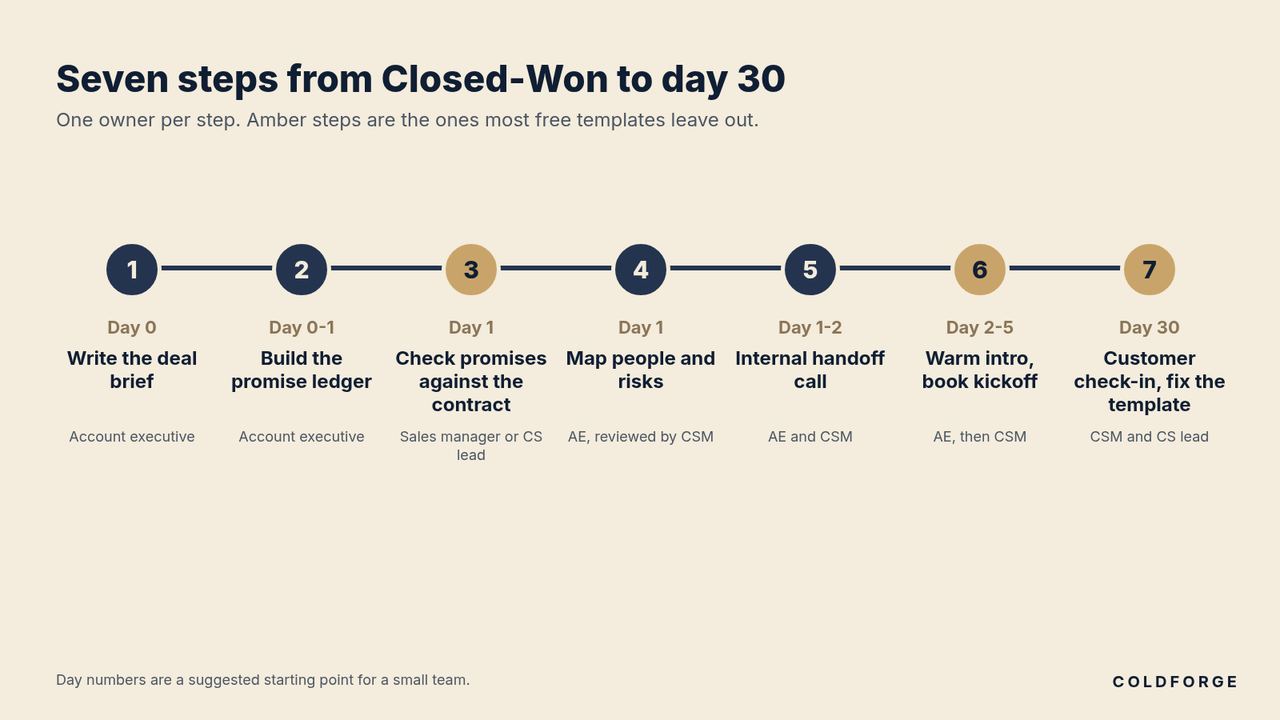
Run these customer onboarding handoff steps as seven short steps over about a week, each with one owner: write the brief, build the promise ledger, check promises against the contract, map people and risks, hold an internal handoff call, send the warm intro and book the kickoff, then check in at day 30. Most steps take under an hour.
Step 1: Write the deal brief on close day
Owner: account executive. When: day 0. Write the brief the day the deal closes, while every call is still fresh. Keep it to one page: the trigger that made the customer act, the alternative they rejected and why, and the outcome they'll measure, in their own words.
Quote the customer wherever you can. A line like "we need month-end close done in five days, not nine" tells a CSM far more than "wants efficiency." The brief isn't the CRM activity log. It's the story the customer believes they bought, and our closed-won packet page lists what belongs in it.
Step 2: Build the promise ledger
Owner: account executive. When: day 0 to 1. A promise ledger is a dated list of every commitment made during the sale, spoken or written. For each line, record what was promised, who said it and when, where it's written down, its status, an owner and a due date. If you need a promise ledger template, the ledger section of our free handoff template has those columns.
Work from the email thread, the proposal and your call notes, not memory alone. The lines that cause trouble are rarely the big ones in the order form. They're the discount that was "just this once," the report sketched on a call, and the go-live date someone mentioned but nobody scoped.
Step 3: Check every promise against the contract
Owner: sales manager or CS lead. When: day 1. Give each ledger line one of three statuses: agreed, still to confirm, or not in the contract. Anything outside the contract needs a decision before kickoff: honour it, defer it to a date, or quote it as extra work. Record the decision in writing, with the account executive and the CS lead both copied.
This is the step most templates skip. In our review further down, only 4 of 11 free handoff templates asked anyone to compare sales promises with the signed contract. It's also the step that prevents the hardest sentence to hear at a kickoff: "But your rep told us."
Step 4: Map the people and the risks
Owner: account executive, reviewed by the CSM. When: day 1. Name the economic buyer, the champion, the day-to-day admin and anyone who argued against the purchase, with a line on what each one cares about. Then list the risks you can already see: a data migration, an open security review, a champion who might move on, or a deadline nobody scoped.
Expect a crowd. GUIDEcx found that 68% of onboarding teams coordinate four or more stakeholders on a typical project, so a single "main contact" field won't hold the real picture.
Step 5: Hold a short internal handoff call
Owners: account executive and CSM. When: day 1 to 2. In 20 to 30 minutes, the account executive walks the CSM through the brief and the ledger with the contract on screen. The CSM's job is to find gaps: anything vague, missing or contradictory.
The account executive answers each gap in writing within two working days, and the CS lead either accepts the handoff or sends it back. Keep this call internal. The customer should never have to watch your team work out what was sold.
Step 6: Send the warm intro and book the kickoff
Owner: account executive, then the CSM. When: day 2 to 5. The account executive emails the champion, introduces the CSM by name and explains why that person is the right owner. Then book the kickoff. The published checklists we reviewed ask teams to schedule it within 48 hours to five business days of signature, so set your own target and track it.
Plan the kickoff around the ledger, not a product tour. Our 60-minute kickoff agenda puts the promise ledger check in the first 15 minutes, with the account executive still on the call, and the Kickoff Pack builds that agenda from your own notes.
Step 7: Hold the day-30 customer review and fix the template
Owners: CSM and CS lead. When: day 30. In the day-30 customer review, ask the customer one direct question: is anything you were promised missing? Compare progress with the success criteria in the brief. Then rate the handoff with the CSM, note what was missing or late, and add one question to your template that would have caught it.
This is the loop most teams never close. Only 3 of the 11 templates we reviewed included any review of the handoff after kickoff.
Every field from these seven steps on a single printable page, with no payment and no signup. Get the Sales to Customer Success Handoff Template.
What goes in the closed-won handoff packet?
The closed-won handoff packet is what the seven steps produce: a one-page deal brief in the customer's words, the promise ledger with a contract status on every line, the people and risks, the kickoff agenda and the warm intro email. Each item has one owner and a date, set by the step that creates it.
We keep the item-by-item list in one place so it stays current. Our sales to CS handoff checklist explains each item, and the sales-to-CS handoff overview covers what to put in the brief. What this guide adds is the sequence around the packet: the contract check on day 1, the warm intro before kickoff, and the review at day 30. Those three are the steps the diagram above highlights, and the ones our template review found missing most often.
What do most free handoff templates miss?
Most free templates cover the basics well but stop at the internal handoff. In our own review of 11 free handoff templates, read on October 31, 2026, all 11 asked for success criteria, stakeholders, promises and risks. Only 4 asked for promises to be checked against the contract, 4 included a warm intro from sales, and 3 reviewed the handoff after kickoff.
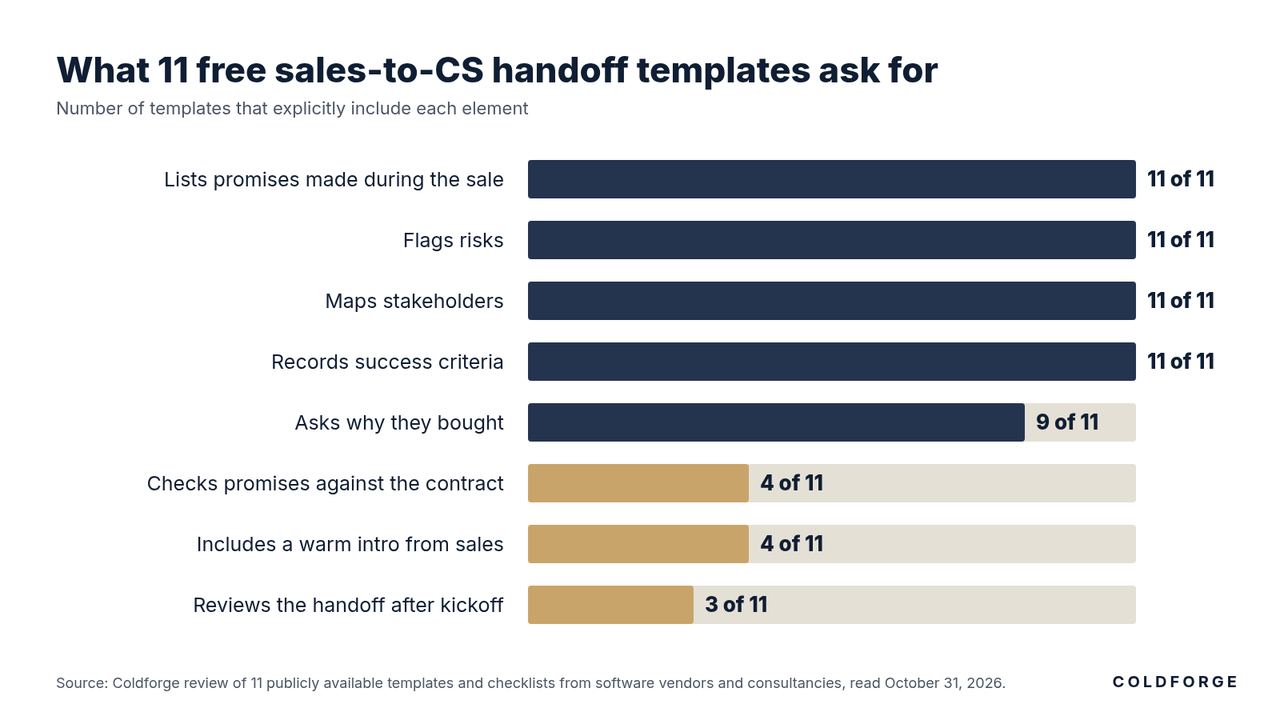
How we counted: we read 11 free templates and checklists published by software vendors and consultancies that appear for sales-to-CS handoff searches, and we counted an element only when the template asked for it explicitly. One template was a gated download, so we scored its public summary. This is Coldforge's own small review by one reader, not an industry survey, so treat it as a pattern in the templates we read, not a rule about every team.
What it means for a small team: you don't need a longer form. You need the three steps around the form, which are the contract check, the warm intro and the day-30 review. Those are what turn a filled-in document into a handoff the customer can actually feel.
Where do AI agents fit in the first 30 days after closed-won?
AI agents fit best at three points in the first 30 days after closed-won: drafting the brief and ledger on close day, flagging ledger lines still unconfirmed before kickoff, and gathering what changed before the day-30 review. A person still decides every contract status and approves anything the customer will see.
Mapped to the steps above, the agent does the reading and the people do the deciding. In steps 1 and 2 it pulls commitments out of long email threads and call notes and tags anything it can't confirm. Before step 6 it lists the lines still marked "to confirm." Before step 7 it collects open tickets and missed dates for the CSM. Steps 3 and 5, the contract check and the internal call, stay human. Our free CRM handoff agent setup guide covers the close-day draft.
Keep the agent's access to the deal record, collect only the personal information the handoff needs, and let it draft and flag, never send. In British Columbia, private businesses handle customer information under the Personal Information Protection Act, and the Office of the Information and Privacy Commissioner for BC publishes plain-language guidance on it.
Canadian businesses are moving. Statistics Canada reports that 25.2% of businesses planned to use AI over the next 12 months as of the third quarter of 2026, up from 14.5% a year earlier. A handoff agent makes a sensible first project because the scope is narrow, the inputs are clear and a human approval step is built in. For more context, read Canadian businesses are moving on AI, and agents are next, and if you're weighing funding, our BC AI funding update covers the intake that closes November 23.
How do you know the handoff worked?
You know it worked when the customer never has to repeat their story and no promise surprises anyone at kickoff. Track a few simple numbers on every deal and review them once a month. The trend across your own deals matters more than any single benchmark.
- Days from Closed-Won to the customer kickoff.
- Ledger lines still marked "to confirm" when the kickoff starts.
- Questions the customer was asked that sales already knew the answer to.
- The customer's answer at day 30 to "Is anything promised missing?"
- Whether onboarding finished on its planned date.
For an outside reference point, OnRamp's 2026 report puts best-in-class time to first value at under 14 days and onboarding completion above 80%. Your numbers will vary with product and deal size, so compare against your own last quarter first.
Where should a small team in Vancouver or BC start?
Start with your next closed deal, not a new platform. Print the free template, fill it in on close day, run the internal call and send the warm intro. If you'd rather have the packet built for you from your own notes, that's what the Kickoff Pack is for.
The Kickoff Pack is CAD $97 plus applicable taxes for one deal. It includes the handoff brief, the promise ledger, a 60-minute kickoff agenda and the warm intro email, AI-drafted and human-reviewed. If you only need the brief, the Starter Brief is CAD $49 plus applicable taxes. Running the kickoff yourself? You can copy the six-block outline of our 60-minute kickoff agenda at no cost, and the printable version comes with the Kickoff Pack. You paste call or CRM notes into a private intake, with no CRM install, and packets usually arrive the same business day after a clean upload, depending on volume.
Already on HubSpot or Pipedrive? Our note on running the handoff without a new platform covers the stack question. Building something bigger, like an AI agent team for sales? See the Agentic Business Launch.
Use the free handoff template, or order a Kickoff Pack and get the full packet for one deal.
Coldforge Agentic Services builds handoff packets and agentic workflows in Vancouver, BC, for small teams that need them to work every day. Questions? Write to [email protected]. Reliable by design.
FAQ
What should a sales to customer success handoff include?
Include why the customer bought in their own words, every promise made during the sale with its contract status, the people who matter, known risks, the kickoff plan and a warm intro from the account executive. Give each item an owner and a date, so gaps get closed before the customer notices them.
Who owns the handoff from AE to CSM?
The account executive owns the handoff until the CS lead accepts it. Sales writes the brief and the promise ledger and answers the CSM's questions. Customer Success owns everything after acceptance, including the kickoff and the day-30 check. The account executive should join the kickoff and stay the escalation contact.
How soon after Closed-Won should the handoff happen?
Start on the day the deal closes, while the details are fresh. Aim to finish the internal handoff within two working days and hold the customer kickoff within about a week. Published checklists ask for it to be booked within 48 hours to five business days of signature. Measure your own timing on every deal.
What is a promise ledger?
A promise ledger is a dated list of every commitment made during the sale, spoken or written. Each line records who made the promise, where it's written down, and whether it's agreed, still to confirm, or not in the contract. It lets your kickoff settle surprises before the customer has to raise them.
What's the difference between a closed-won packet and a handoff template?
A handoff template is the blank form. A closed-won packet is the finished set for one deal: the brief, the promise ledger, the kickoff agenda and the warm intro email, filled in from real notes. Use the free template to build your own, or have a packet made for you from your notes.
Can AI write handoff notes from my CRM?
Yes. An AI agent can read the deal record, call notes and emails and draft the brief and promise ledger in minutes. It can miss context or misread a promise, so a person must review the draft before anyone acts on it. Keep the agent to drafting and flagging, and never let it send.
Is it safe to use AI with customer data in BC?
It can be, with care. Collect only what the handoff needs, limit the agent to the deal record, and check where your AI tool stores data. BC's Personal Information Protection Act governs how private businesses handle personal information, and the privacy commissioner's guidance explains the rules. This article isn't legal advice.
Sources
- GUIDEcx, The State of Customer Onboarding in 2026: guidecx.com
- GUIDEcx, Why customers churn during onboarding: guidecx.com
- GUIDEcx, How to manage multiple stakeholders during customer onboarding: guidecx.com
- Journal of the Academy of Marketing Science (2025), Unintended consequences of selling B2B digital subscription add-ons for customer onboarding: link.springer.com
- OnRamp, 2026 State of Customer Onboarding: onramp.us
- Salesforce, State of Sales 2026 announcement: salesforce.com
- Gartner, AI agents will outnumber sellers 10 to 1 by 2028 (July 28, 2026): gartner.com
- Statistics Canada, Planned use of AI by businesses in Canada, third quarter of 2026: statcan.gc.ca
- Office of the Information and Privacy Commissioner for BC, guidance for private organizations: oipc.bc.ca
- Template review: 11 free sales-to-CS handoff templates and checklists from software vendors and consultancies, read October 31, 2026.